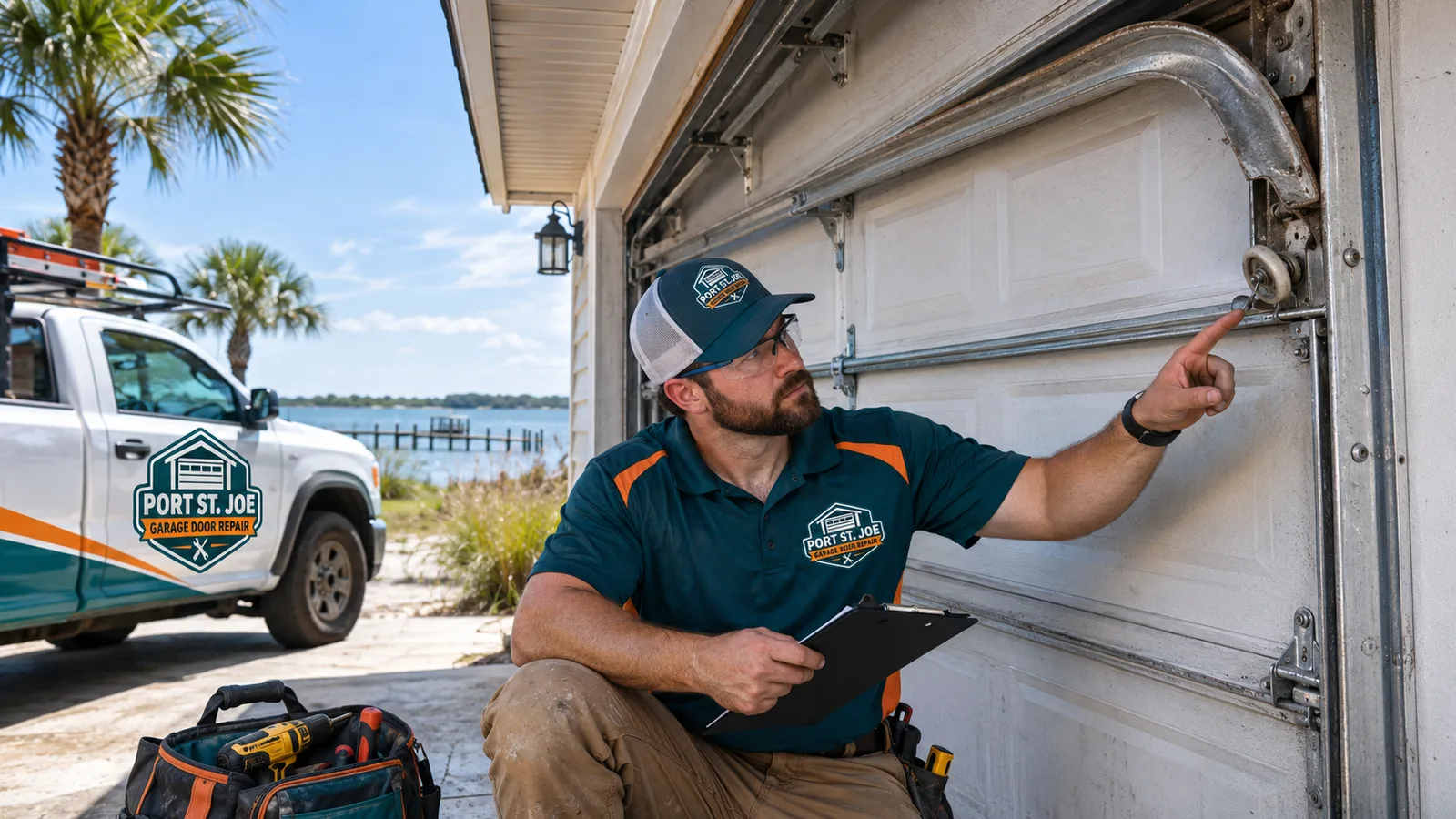
A residential garage door visibly out of alignment, with one roller displaced from the vertical track while the door remains secured

Off-track garage door service in Port St. Joe, Florida

Garage Door Off Track Repair Port St. Joe FL

Stop operating the door and have the rollers, tracks, cables, and supporting hardware inspected before the damage spreads.

✓Rollers, tracks, cables, and hardware ✓Alignment and full-travel testing

Stop before damage spreads

A Crooked Door Needs Attention Before It Moves Again

When a door hangs unevenly, binds in the opening, or has a roller outside its track, continuing to use the opener can bend the track, damage more rollers, or pull a cable loose. Garage door off track repair in Port St. Joe, FL starts with keeping the door still and determining why it left the track.

Port St. Joe Garage Door Repair checks the full operating path rather than pushing a roller back into place and assuming the problem is solved. Our garage door specialists serving Port St. Joe inspect the affected track, roller stems, hinges, lift cables, brackets, and door alignment before recommending the repair.

Do not stand beneath a tilted door or try to force it closed. Avoid pulling the emergency release when the door is crooked because the opener may be helping hold part of its weight. If a vehicle is trapped, leave the door in place until its condition can be assessed.
Diagnose the derailment

What Causes a Garage Door to Come Off Its Track?

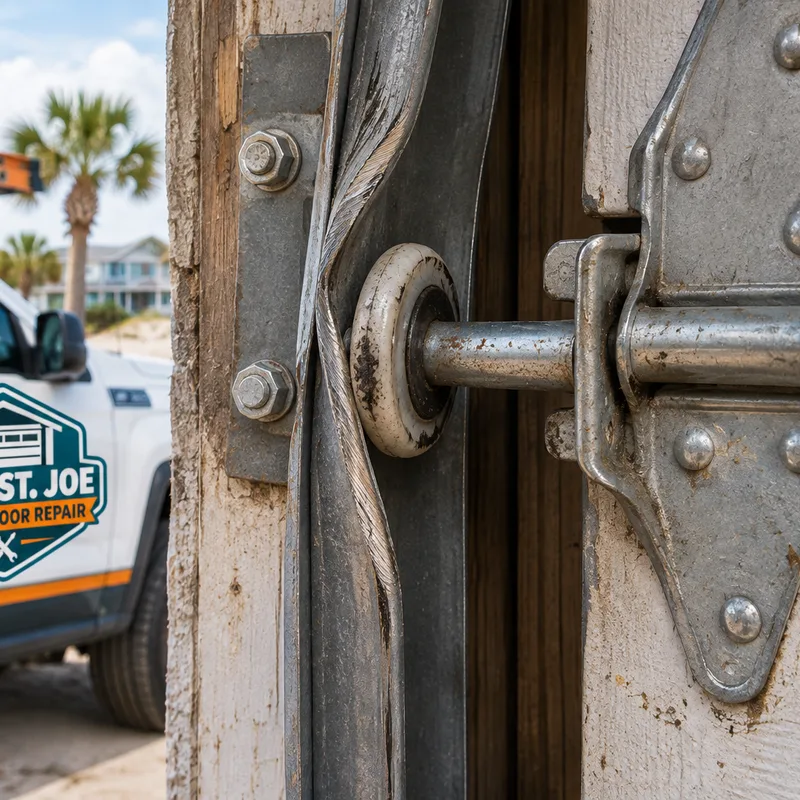
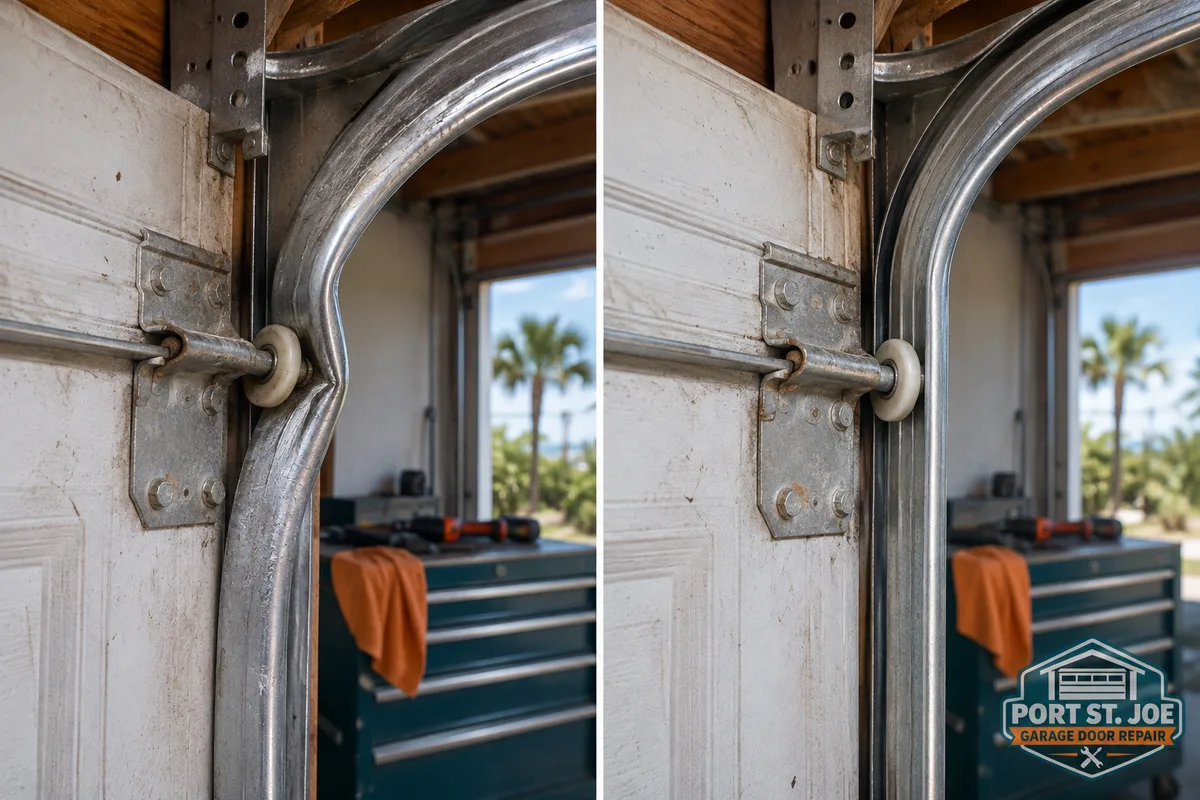
Close view of a garage door roller outside a bent vertical track, with the lift cable and bracket visible for diagnostic context
A displaced roller may be the visible result of track, hinge, or cable trouble.

An off-track door is usually a symptom of another fault. A roller may have worn down, seized, or slipped from a track that spread at a joint. A track can also bend after contact with a vehicle or other object. Loose track brackets, damaged hinges, and a door that was obstructed while closing can create enough misalignment for a roller to escape.

Lift-cable trouble requires particular care. If one cable loses tension, slips from a drum, or becomes tangled, one side of the door may rise while the other stays low. That uneven load can pull rollers from the track. The cable is part of a counterbalance system under substantial tension, so it should not be removed, cut, or wrapped back onto a drum as a do-it-yourself repair.

Along the Florida Panhandle coast, wind-driven rain and salt-laden air can contribute to corrosion on exposed steel hardware. Corrosion alone does not prove why a door derailed, but rusty fasteners, rough roller bearings, and weakened cable strands deserve attention during an inspection.

Warning signs

Signs the Door Should Stay Put

A Roller Is Outside the Track

Even one displaced roller can let the door twist as it moves. Stop the opener and keep people away from the opening.

The Door Is Crooked

A lower corner or uneven gap can indicate a cable, drum, roller, or alignment problem. The imbalance may worsen if the door cycles again.

A Cable Is Loose or Tangled

A slack cable may hang beside the track or overlap on the drum. Do not touch it or attempt to reset it while the system is under tension.

The Track Is Bent or Separating

A crushed track, widened seam, or loose mounting bracket can prevent the rollers from following their intended path.

The Opener Strains or Stops

The opener is not designed to correct a mechanically jammed door. Repeated attempts can add stress to the door and operator.

The Door Was Hit

Impact can shift the track and damage roller stems or brackets even when the bend initially appears minor.

From stabilization to testing

How Off-Track Garage Door Repair Works

  1. Step 1 of 5

    Secure the Door

    Port St. Joe Garage Door Repair first assesses the door's position and keeps it from moving unexpectedly. A hanging or tilted door must be stabilized before hardware is adjusted.

  2. Step 2 of 5

    Find the Original Fault

    The inspection follows the roller path and checks the vertical and horizontal tracks, hinges, brackets, cables, drums, and visible spring-system condition. This identifies whether impact, wear, loosened hardware, or uneven lifting led to the derailment.

  3. Step 3 of 5

    Realign or Replace Damaged Parts

    Repair may involve correcting track alignment, fastening brackets, resetting suitable rollers, or replacing damaged rollers, hinges, track pieces, or cables. Parts are chosen according to the door and the condition found.

  4. Step 4 of 5

    Reset the Door in Its Tracks

    Once the cause is addressed, the door is returned to the correct roller path. Cable routing and track spacing are checked before the door is allowed to travel normally.

  5. Step 5 of 5

    Test the Full Travel

    The repaired door is operated through its travel to check alignment, clearance, balance, and opener response. A complete test can reveal binding that is not visible while the door is stationary.

Complete mechanical correction

Repairing the Cause, Not Only the Displaced Roller

Technician tools positioned beside a secured garage door track during measurement of track spacing and roller alignment, with no person shown
Track spacing, bracket position, and roller condition all affect reliable travel.

A roller can sometimes be returned to an undamaged track, but that is only part of a proper repair. Track spacing must allow the rollers to travel without binding or excessive side-to-side movement. Mounting brackets must be secure, hinges must hold the roller stems correctly, and both sides of the door need to lift together.

Bent steel is evaluated according to its location and severity. A small alignment issue may be correctable, while a sharply creased or crushed track section may need replacement. Worn nylon or steel rollers, bent stems, cracked hinges, and frayed cables are evaluated separately rather than treated as one problem.

The opener is checked after the door moves correctly by hand under controlled conditions. Opener adjustments cannot compensate for a binding track or an uneven cable system. Mechanical alignment comes first, followed by a travel and safety check.

If the door is tilted, jammed, or supported unevenly, leave it stationary and arrange an inspection before using the wall control, remote, or emergency release.

CALL NOW: (850) 403-9289

Practical answers

Garage Door Off Track Repair Questions

Can I close a garage door after a roller pops out?+

Do not operate or force an off-track garage door closed. Movement can pull additional rollers free, deform the track, or disturb the lift cables. In Port St. Joe's windy or wet weather, protect belongings from inside the garage if that can be done without approaching or passing beneath the unstable door.

Can an off-track door usually be repaired, or does it need replacement?+

Many off-track doors can be repaired when the door panels and supporting structure remain serviceable. The appropriate repair depends on impact damage, track deformation, hinge condition, roller damage, and whether the door itself has twisted. Port St. Joe Garage Door Repair determines that after stabilizing and inspecting the assembly.

How long does garage door off-track repair take?+

A straightforward roller and alignment repair may be completed during one service visit, while bent track, cable damage, or parts that must be matched can take longer. The door's position also affects timing because a severely tilted door requires careful stabilization before repair begins.

Why is one garage door cable loose after the door came off track?+

A loose cable often means the two sides of the door are no longer moving together or the cable has lost its proper position on the drum. The cable may be a cause or a result of the derailment. Because the counterbalance system stores substantial force, the cable and drum should be handled only after the door is secured.

Can the opener pull the garage door back onto the track?+

No, the opener should not be used to pull a derailed door back into alignment. An opener moves a door that already travels correctly; it does not straighten bent track, reset cable tension, or control a tilted door safely. Disconnecting it can also allow unexpected movement, so leave the system untouched until it is assessed.

Should tracks and rollers be inspected after a minor vehicle bump?+

Yes, the struck track, mounting brackets, roller stems, hinges, and door travel should be checked after an impact. A small shift at the floor can change track spacing farther up, and operating the door may turn a limited bend into a derailment.

Prevent further damage

Keep an Off-Track Garage Door From Getting Worse

Keep the door still until its tracks, rollers and lifting hardware can be assessed.