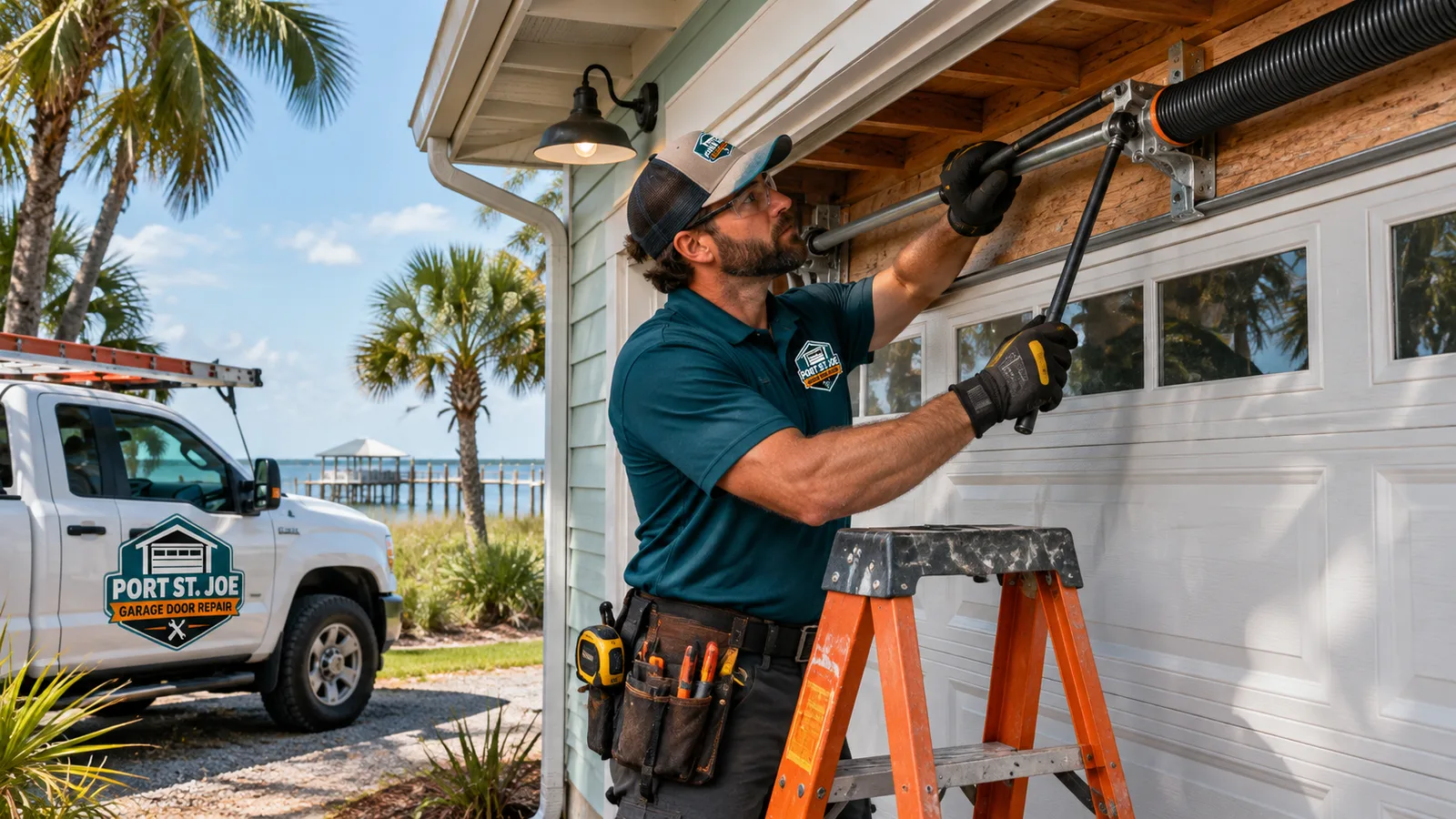
A residential garage door technician using winding bars to adjust a torsion spring mounted safely above a closed garage door

Garage door spring service in Port St. Joe, Florida

Garage Door Spring Repair Port St. Joe FL

Get a heavy, uneven, or stuck garage door properly assessed, fitted with the correct replacement spring, and balanced for controlled operation.

✓Torsion and extension springs ✓Spring sizing and balance testing

Broken spring diagnosis

Help for a Broken or Worn Garage Door Spring

When the door suddenly feels too heavy to lift, stops partway, or leaves a visible gap in a spring, garage door spring repair in Port St. Joe, FL is usually the right service to request. Springs counterbalance the weight of the door. Once one breaks or loses tension, the opener may no longer move the door safely.

Port St. Joe Garage Door Repair assesses the spring system, door weight, cables, drums, bearings, and balance before recommending a repair. As Port St. Joe's trusted garage door team, we focus on identifying the failed component and matching the replacement to the door rather than installing a spring based on appearance alone.

Do not keep pressing the opener button if the door barely moves. The opener is designed to guide a balanced door, not lift its full dead weight. Repeated attempts can strain the motor, bend the top door section, or allow a cable to leave its drum. Keep people and vehicles clear of the opening until the system has been inspected.
Correct spring selection

Torsion and Extension Spring Repair

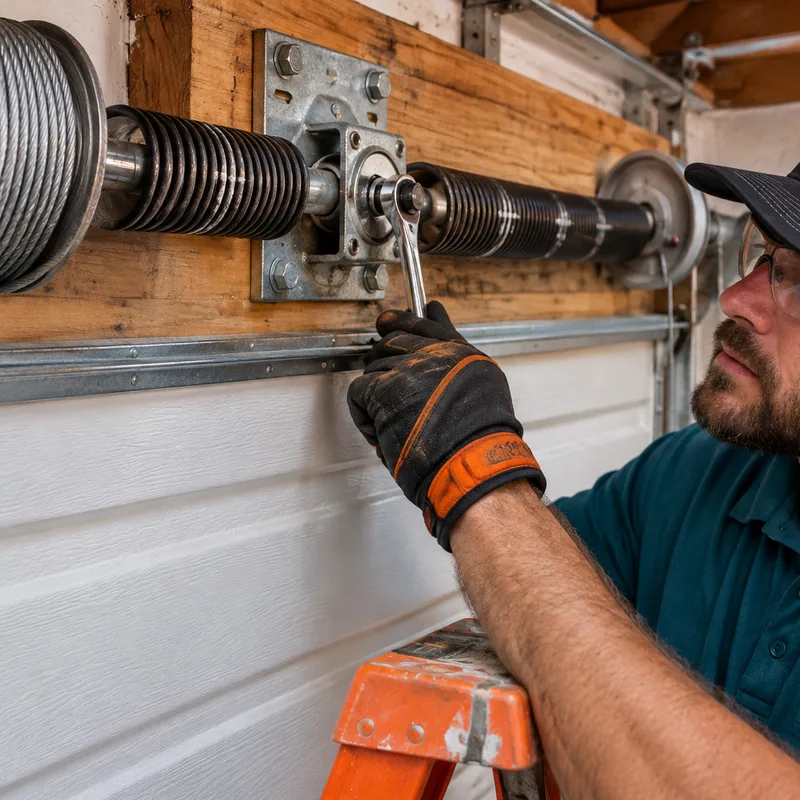
A close comparison of a torsion spring assembly and an extension spring with its pulley and safety containment cable

A torsion spring sits on a shaft above the door and applies torque through cable drums. A broken torsion spring often has a clear separation in the coil. Some doors use two torsion springs, and one may remain intact after the other fails. The door is still unbalanced and should not be operated normally.

Extension springs run beside the horizontal tracks and stretch as the door closes. Their repair requires attention to the springs, pulleys, lift cables, and safety containment cables. A missing or damaged containment cable matters because it is intended to restrain an extension spring if the spring breaks.

Spring selection depends on the door's actual weight and the spring's dimensions, including wire size, inside diameter, and coil length. For torsion systems, wind direction also matters. Port St. Joe Garage Door Repair checks these factors and sets tension with the door secured before testing the balance. Springs are not safely interchangeable simply because they look similar.

Common warning signs

Signs the Spring System Needs Attention

The door will not lift

A door that moves only a few inches before stopping may have a broken spring. Stop using the opener rather than forcing it to carry the door's full weight.

The door feels unusually heavy

Disconnecting an opener does not make a failed spring safe. If the door cannot be controlled comfortably by hand, leave it closed and arrange an inspection.

The door rises unevenly

A tilted door can indicate uneven spring force, a displaced cable, or another counterbalance problem. Continuing to move it can pull rollers or cables out of position.

A coil has a visible gap

A separation in a torsion spring is a strong sign that the spring has broken. The gap is often easy to see on the shaft above the door.

The cables look loose

Lift cables may lose tension when a spring breaks. Do not pull, cut, or attempt to wind them back onto the drums while the spring system is loaded.

The door closes hard

Weak or poorly matched springs may leave the door difficult to control. A balance test helps distinguish spring trouble from an opener setting or track problem.

Local operating conditions

Spring Repair for Port St. Joe's Coastal Conditions

Port St. Joe's coastal air can contribute to corrosion on exposed garage door hardware. Rust does not prove that a spring is about to fail, but heavy corrosion, pitting, stretched coils, frayed cables, or rough bearings should be considered during the repair. Wind-driven moisture can also reach hardware near the edges of an opening, so a useful inspection covers more than the obvious break.

The door itself may also carry extra weight after reinforcement, hardware changes, or replacement of individual sections. That affects spring selection. A spring should be chosen for the measured door weight and the geometry of the lift system, not merely copied from an old spring that may already have been the wrong size.

Port St. Joe Garage Door Repair checks how the door rests on the floor, travels through the tracks, and holds at intermediate positions. A properly balanced door should remain controlled through its travel without the opener compensating for excessive spring force or dead weight.

From inspection to testing

How Garage Door Spring Repair Works

  1. Step 1 of 5

    Secure and inspect the door

    The door is kept in a stable position while the spring system, shaft, drums, cables, bearings, tracks, and opener connection are examined. This establishes whether the spring is the main failure or one part of a larger mechanical problem.

  2. Step 2 of 5

    Identify the correct spring

    The technician determines the door weight and records the measurements needed for a compatible torsion or extension spring. Spring type, dimensions, wind direction, and lift arrangement are checked before installation.

  3. Step 3 of 5

    Remove stored tension safely

    Any remaining spring force is controlled with the proper tools. On torsion systems, the shaft and winding hardware are secured. Extension systems require control of the stretched spring and associated cable-and-pulley components.

  4. Step 4 of 5

    Install and set the replacement

    The replacement spring is fitted, cables are seated correctly, and tension is adjusted for the door. Related hardware is checked for wear or displacement before the system is operated.

  5. Step 5 of 5

    Balance and function test

    The door is moved by hand through its travel and checked at several positions. Once the door is balanced and tracks correctly, the opener can be reconnected and tested under normal load.

High-tension hardware

Why Spring Replacement Is Not a Safe Trial-and-Error Repair

Garage door springs store substantial mechanical energy. Torsion springs are wound under load, while extension springs stretch along the tracks. Improvised tools, incorrect winding direction, or an unsecured door can cause the winding bar, shaft, spring, or door to move without warning.

Incorrect spring sizing creates a second problem even when installation appears successful. Too little spring force leaves the door heavy and burdens the opener. Too much force can make the door rise on its own or resist closing. Either condition indicates that the counterbalance system is not properly matched.

Avoid loosening set screws, cutting cables, clamping a broken spring together, or placing hands near cable drums and pulleys. Port St. Joe Garage Door Repair can assess the complete system and set the replacement spring according to the door rather than relying on guesswork.

A broken spring can leave the door too heavy to control and place unnecessary load on the opener. Arrange an assessment before trying to move the door again.

CALL NOW: (850) 403-9289

Practical answers

Garage Door Spring Repair Questions

Can I open my garage door after a spring breaks?+

Leave the door closed unless moving it is necessary for immediate safety. A broken spring removes much of the counterbalance force, so the door may be extremely heavy and can fall or tilt. If a vehicle is trapped, tell Port St. Joe Garage Door Repair when arranging service so the access issue can be considered before work begins.

Should both garage door springs be replaced at the same time?+

Replacing both may be appropriate when a two-spring system has springs of similar age, condition, and service history, but that recommendation should follow an inspection. The technician should also verify that both springs are correctly matched to the measured door weight. A paired replacement is not a substitute for proper sizing.

How long does garage door spring replacement take?+

A straightforward residential spring replacement is often completed during one service visit, but the actual time depends on the spring system and related damage. Displaced cables, worn bearings, damaged drums, unusual spring sizes, or a door stuck at an angle can add work. The repair should finish with balance and opener tests rather than installation alone.

Is the opener broken if it hums but the door will not rise?+

The opener may be reacting to a door that has lost spring assistance rather than suffering an internal failure. A visible spring gap, loose lift cables, or a door that feels extremely heavy points toward the counterbalance system. Stop running the opener until the door and spring assembly have been inspected.

Can a rusty spring be repaired instead of replaced?+

A broken, cracked, heavily pitted, or permanently stretched spring is generally replaced rather than patched. Surface rust alone does not determine the answer, but Port St. Joe's coastal exposure makes it sensible to inspect the coils, cones, shaft, cables, and bearings together. The door's measured balance should guide the final recommendation.

How is the correct replacement spring selected?+

The correct spring is selected using the door's weight and the specifications of its lift system. For torsion springs, relevant details include wire size, inside diameter, length, and wind direction. Extension springs must also match the door weight and track arrangement. Color marks or visual similarity alone are not enough.

What should I do if the garage door is stuck open?+

Keep people clear of the opening and do not stand beneath the door or pull on loose cables. A door stuck open may have stored spring tension, compromised cables, or unstable rollers. Port St. Joe Garage Door Repair should assess how to secure and lower it before replacing parts.

Restore proper balance

Get the Spring System Properly Assessed

A broken coil, loose cable or unusually heavy door indicates that the spring system needs a professional inspection.